How to Buy a New Construction Home in the United States in 2026

The real, data-based guide explained clearly
Lucid_Origin_Buying_a_home_in_the_United_States_is_one_of_the__3 (1)

Buying a home in the United States is one of the most important financial and personal decisions a family can make. Yet most people don’t realize that the process changes dramatically depending on the state, the local market, and the stage of construction.

And when you don’t understand those differences, you can lose money, time, and opportunities that do exist—but not always where most buyers are looking.

This guide brings together data updated through September and October 2025, using sources such as the U.S. Census Bureau, NAHB, NAR, Redfin, Realtor.com, and Freddie Mac.
My goal is to help you interpret that information so you can make clear and confident decisions, whether you’re new to the country, relocating, or navigating a system that works very differently than the one you’re used to.

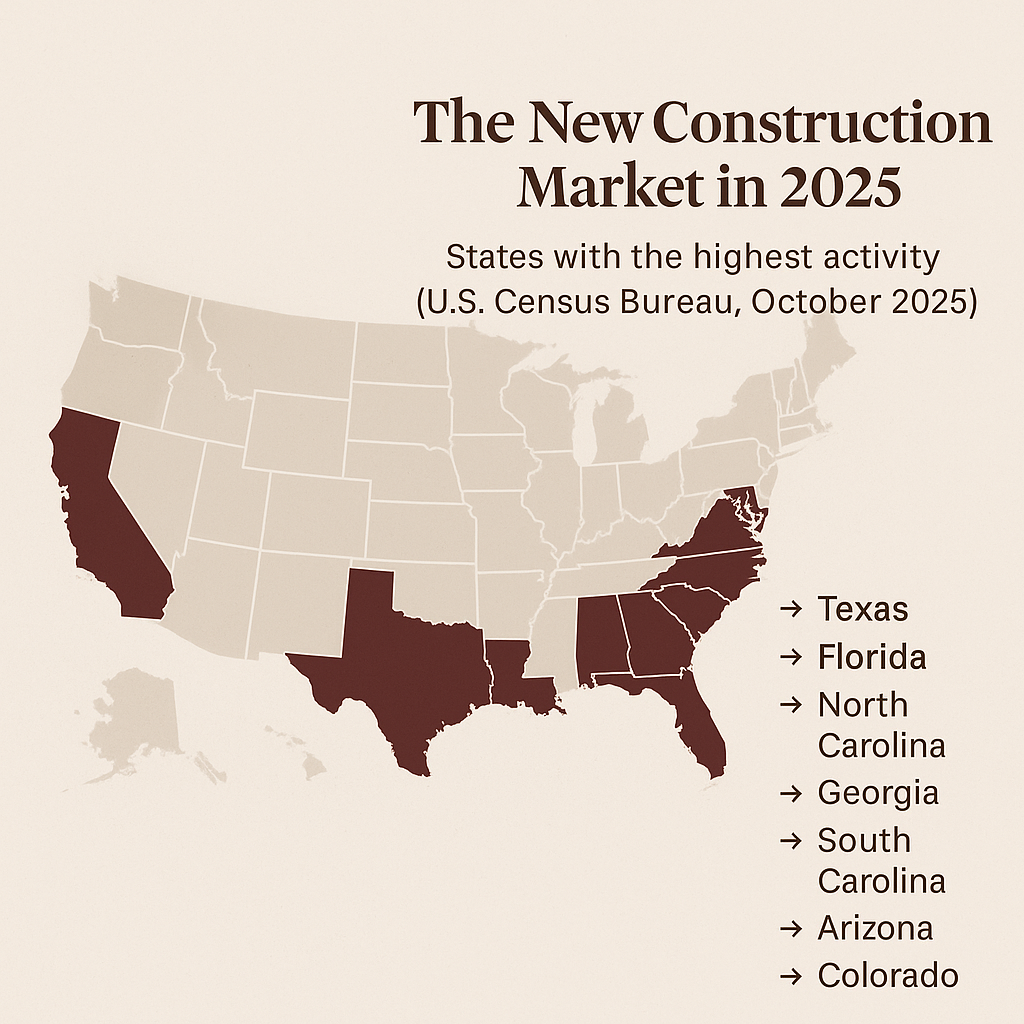
1. The New Construction Market in 2025

States with the highest activity (U.S. Census Bureau, October 2025)

According to the U.S. Census Bureau’s National New Construction Report, more than 65% of all new construction in the country is concentrated in these states:

Texas, Florida, North Carolina, Georgia, South Carolina, Tennessee, Arizona, and Colorado

Why does this matter?
Because markets with higher building activity often offer:

  • more options
  • more supply
  • more price ranges
  • more quick-move-in inventory
  • and in many cases, more builder incentives

In contrast, Realtor.com and Redfin data from September and October 2025 show that states such as:

California, New York, New Jersey, Washington and Massachusetts

tend to have lower inventory, fewer new construction options, and more competition among buyers.

This doesn’t mean one state is “better.”
It simply means the buying experience varies significantly depending on the market.

3. The real process of buying a new construction home in the U.S.

A simple, updated model for 2025

Step 1 — Full pre-approval
A pre-qualification is not enough.
A full pre-approval opens access to:

  • Reserved inventory
  • internal lists
  • homes not yet published
  • quick-move-in options

It positions you well without committing to anything.

Step 2 — Review builder programs clearly and carefully
According to NAHB (October 2025):

  • Some builders are offering temporary incentives,
    special financing programs,
    or assistance with closing costs.
  • Not all buyers qualify, and not all communities offer them, but this information can be helpful depending on your situation.

Step 3 — Choose the right community and the right phase
Communities develop in “phases.”
In many Sun Belt markets, buying during an early phase may give you more choices or more flexibility with selections.

This is especially common in Charlotte, Raleigh, Dallas, Austin, Orlando, Atlanta, Nashville and Phoenix.

Step 4 — Pre-drywall inspection
Even with a brand-new home, a pre-drywall inspection gives you full transparency before walls are closed.
It helps identify corrections early and is considered one of the strongest best practices.

Step 5 — Final walkthrough and warranties
Most builders offer:

  • Cosmetic warranty: around 1 year
  • Systems warranty: 1–2 years
  • Structural warranty: up to 10 years (varies by builder)
Every builder has its own documents and procedures.

2. Why are so many people considering new construction in 2025

The National Association of Home Builders (NAHB) reported in October 2025 that:

  • 58% of builders are offering some form of incentive.
  • 31% are offering special rate programs.
  • In some markets, buyers receive help with closing costs
    Structural.
  • warranties remain active in most new communities

These points are not guarantees or promises.
They are public data that help explain why many first-time buyers and newcomers consider new construction.

For many, new construction offers three major advantages:

  • Predictability: fewer major repairs at the beginning.
  • Clarity: the process is structured and guided.
  • Warranties: each builder has specific coverage options.

If you’re relocating or adapting to a new system, this clarity can be a major relief.

4. What changes if you buy resale?

Real NAR data (September 2025)

The National Association of Realtors reports that the average resale buyer spends:

  • 6720 dollars on repairs during the first year
  • 1900 dollars on urgent maintenance

This doesn’t mean resale is “bad.”
It simply has a different cost profile and set of responsibilities.
The key is understanding both models before choosing.

5. Migration trends and real opportunities in 2025

According to the U-Haul Migration Index 2025, the states receiving the most new residents are:

  • Florida – Texas
  • North Carolina
  • Tennessee – Georgia
  • South Carolina

When migration increases, housing development often follows, creating more community options and expanding new construction availability.

Conclusion

Buying a home in the United States is not about luck.
It is about understanding the system, reading the right data, and making decisions based on your goals, your documents, and your timeline.

If you know someone new to the country or relocating to another state, sharing accurate information can make a meaningful difference in their stability and confidence.

Life is too short to be small!

Ready for More?

Your journey doesn’t end here, your best decisions begin with clarity.

📝 Contact now 📩 Schedule Your Strategy Call | 🏡 Browse Luxury Listings

Real Estate. Strategy. Financial Freedom​

I work with professionals to achieve financial freedom through real estate, impactful projects, and strategic financial guidance.

The information you provide will be used to contact you regarding services, opportunities, and resources aligned with your real estate goals and strategic projects. You may opt out of communications at any time.